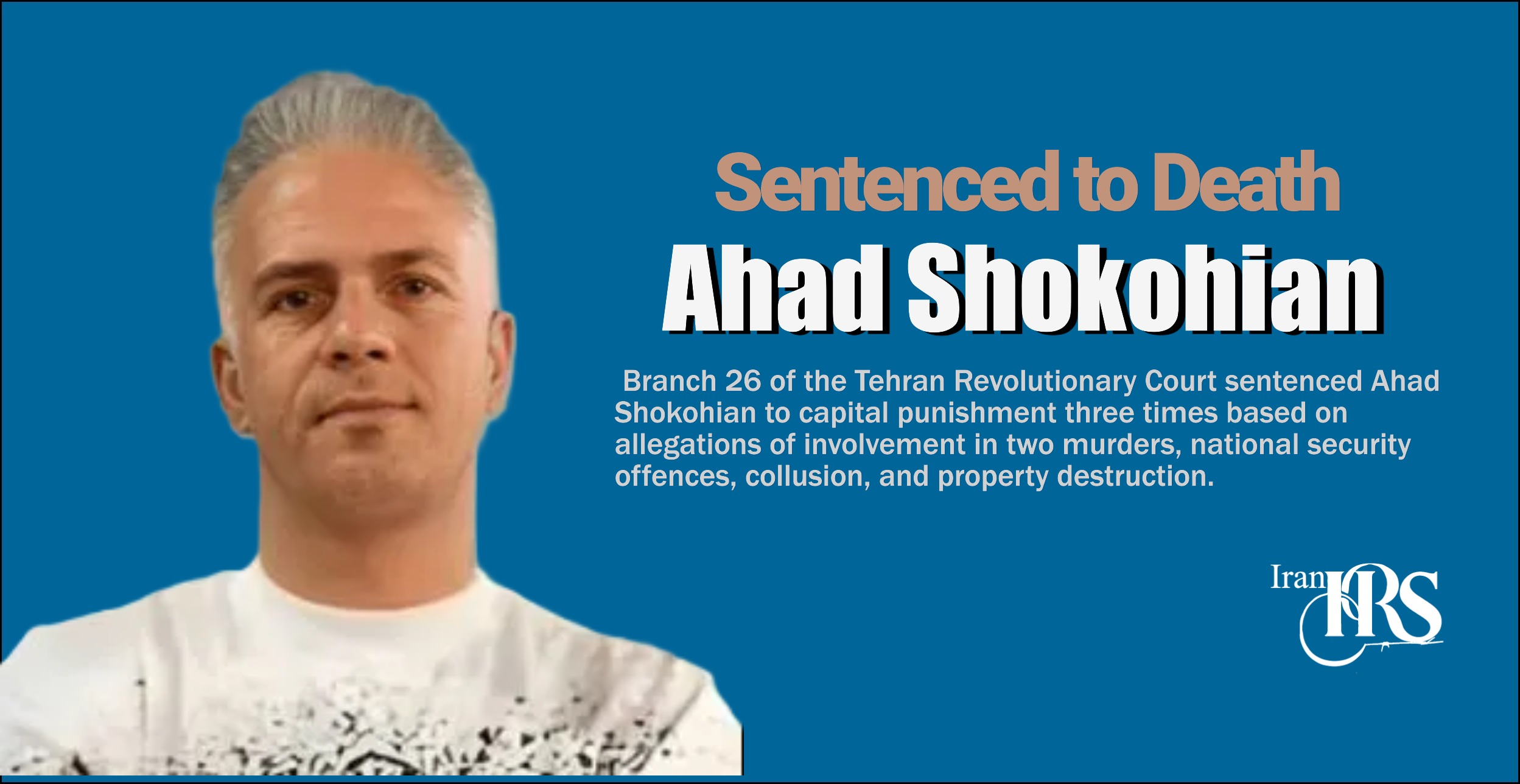
Ahad Shokohian, a detainee from the January 2026 nationwide protests, has been sentenced to death three times by Branch 26 of the Tehran Revolutionary Court, presided over by Judge Iman Afshari. This verdict comes despite a medical examiner’s report officially confirming his severe asthma and resulting physical limitations.

Iran Human Rights Society, Thursday, July 23, 2026– Ahad Shokohian, arrested during the January 2026 nationwide protests, has received three execution sentences from Branch 26 of the Tehran Revolutionary Court under Judge Iman Afshari. He is named as the third defendant in this multi-defendant case.
According to published reports, Shokohian, 38, was arrested on January 15, 2026, in Pakdasht, Tehran. The allegations leveled against him include “participation in two counts of intentional murder,” “acting against national security,” “assembly and collusion against national security,” and “destruction of public property.”
Key Information | Ahad Shokohian
| Title | Details |
| Name | Ahad Shokohian |
| Age | 38 years old |
| Arrest Date | January 15, 2026 |
| Arrest Location | Pakdasht, Tehran |
| Detention Facility | Ghezel Hesar Prison, Karaj |
| Court | Branch 26, Tehran Revolutionary Court |
| Presiding Judge | Iman Afshari |
| Sentence | Sentenced to execution three times |
| Medical Condition | Diagnosed with severe asthma |
Issuance of Three Execution Sentences
According to available details, Branch 26 of the Tehran Revolutionary Court sentenced Ahad Shokohian to capital punishment three times based on allegations of involvement in two murders, national security offences, collusion, and property destruction.
Shokohian’s case is tied to the broader wave of detentions following the January 2026 protests, during which numerous citizens were arrested across various cities and charged with security-related offenses.
Transfer to Ghezel Hesar Prison
Reports indicate that Shokohian was transferred to Ghezel Hesar Prison in Karaj in mid-June 2026, where he remains in custody.
Ghezel Hesar Prison is a primary facility holding security detainees and death-row prisoners. Over recent months, the facility has frequently appeared in human rights reports regarding executions, hunger strikes, and inmate conditions.
Medical Examiner’s Report and Legal Ambiguities
A critical element in Ahad Shokohian’s case is the official forensic medical report detailing his health. Medical examiners officially confirmed that he suffers from severe asthma, which imposes severe restrictions on his ability to perform strenuous physical activities.
Given that Shokohian is listed as the third defendant and faces charges involving physical participation in events, the medical findings directly bear on evaluating his physical capacity and role. However, full judicial arguments addressing how the court weighed this medical evidence have not been made public.
Concerns Over Due Process
The triple execution sentence has heightened concern among human rights advocates regarding trial standards in protest-related cases. Activists repeatedly stress that capital cases necessitate rigorous adherence to fair trial guarantees, full access to legal representation of choice, comprehensive evidence evaluation, and judicial transparency.
Legal Review Based on Domestic Laws
Judicial Considerations
The Iranian judicial framework faces ongoing scrutiny from legal scholars and human rights monitoring organizations over due process standards, ambiguity in security trials, and the extensive application of capital punishment. In Shokohian’s case, the severity of the sentence reinforces the necessity of strict compliance with legal safeguards.
Legal Ambiguities
Although official medical documentation confirms Shokohian’s physical limitations due to severe asthma, the extent to which the court factored this into determining criminal liability remains unclear. Full written arguments and evidentiary assessments have not been publicly disclosed.
Relevant Statutory Provisions
- Article 32 of the Constitution: Prohibition of arbitrary detention and mandate for prompt formal communication of charges.
- Article 35 of the Constitution: Guaranteed right to legal counsel.
- Article 37 of the Constitution: Presumption of innocence until guilt is proven in a competent tribunal.
- Code of Criminal Procedure: Requirement for impartial proceedings, thorough evidentiary assessment, and complete defense rights.
Statutory Non-Compliance Concerns
- Lack of clarity on how the medical examiner’s findings were evaluated.
- The necessity of re-evaluating the defendant’s alleged physical role in light of confirmed physical limitations.
- Obligation to observe full due process guarantees in proceedings leading to capital punishment.
Human Rights Framework
Imposing capital sentences in trials characterized by unanswered questions regarding defense rights and evidence assessment continues to draw international concern. Human rights organizations maintain that proceedings carrying the death penalty demand the highest standards of due process.
Related International Standards
- Article 3, Universal Declaration of Human Rights (UDHR): Right to life, liberty, and security of person.
- Article 10, UDHR: Right to a fair and public hearing by an independent and impartial tribunal.
- Article 14, International Covenant on Civil and Political Rights (ICCPR): Right to a fair trial, effective defense, and access to legal counsel.
- Article 6, ICCPR: Protection of the inherent right to life and strict restriction on the implementation of capital punishment.
See also the below articles:
- Amirhasan Akbari-Monfared Death Sentence: Political Prisoner Sentenced in Evin
- Mehdi Khanaki Executed: Fast-Tracked Sentence Raised Rights Concerns
Follow Iran Human Rights Society on social networks:
Telegram /Twitter /Instagram / YouTube / Facebook
Join Iran Human Rights Society on Twitter