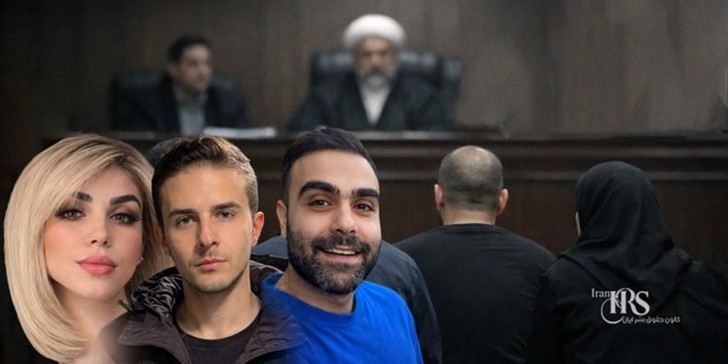
Reports indicate confessions under duress, lack of clear evidence, and the controversial background of the judge in the case in issuing the death sentence.
Iran Human Rights Society, Monday, April 13, 2026 – The issuance of death sentences for four detainees from the December 2025 protests by Branch 26 of the Tehran Revolutionary Court has sparked a wave of concerns about the judicial process, the legal validity of the verdicts, and the possibility of obtaining confessions under torture. These sentences have been issued while numerous ambiguities in the documents and the manner of handling the case have been raised.

Details of the Issuance of Death Sentences for the Protesters
According to the verdict issued by Branch 26 of the Tehran Revolutionary Court presided over by Judge Iman Afshari, four of the detainees from the December 2025 protests, including Mohammad Reza Majidi Asl, Bita Ali Hemmati, Behrouz Zamani Nejad, and Kourosh Zamani Nejad, have been sentenced to death on the charge of “operational action for the hostile government.”
These individuals have also been sentenced to five years of ta’zir imprisonment on the charge of “assembly and collusion against national security,” and a verdict for the confiscation of all their property has also been issued for them. In the same case, Amir Hemmati, the fifth-ranked defendant, has been sentenced to five years and eight months of imprisonment.
General Charges and Lack of Differentiation of the Defendants’ Roles
In the text of the issued verdict, examples such as participating in protest gatherings, chanting slogans, throwing objects, and destroying public property are mentioned as reasons for the charges. There are also claims about the use of explosive materials and damage to stationed forces.
However, the issued verdict does not provide precise and differentiated details about the role of each defendant, and the manner of attributing these charges to the individuals is not clearly specified. This issue has been raised by legal observers as one of the fundamental weaknesses of the case.
Confessions Under Duress; the Main Axis of Concerns
According to the published information, these defendants were under pressure during the interrogation period, and concerns have been raised about obtaining confessions under torture.
Sources close to the families have stated that the obtained confessions were taken in conditions where the defendants were in an unfavorable situation and under pressure. In such conditions, the validity of these confessions as the main document of the case is placed under serious doubt.
In many similar cases, confessions obtained under pressure have been used as one of the determining factors in issuing heavy sentences, including death sentences.
The Role of Judge Iman Afshari in Issuing Heavy Sentences
Judge Iman Afshari, the head of Branch 26 of the Tehran Revolutionary Court, has previously also played a role in issuing heavy sentences for defendants in political and security cases. Some reports and analyses indicate his long history in handling cases related to protests and issuing severe sentences.
The name of this judge has been mentioned in recent years in numerous cases in which criticisms have been raised regarding the manner of handling, the speed of issuing verdicts, and the degree of reliance on confessions. This background has also added to the sensitivities in the recent case.
Lack of Legal Citations and Doubt in the Legitimacy of the Verdict
One of the most important criticisms of this case is the lack of clear legal citations in the issued verdict. According to observers, the raised charges have been expressed in general terms, and precise and documented details to prove them have not been provided.
Also, the lack of differentiation of crimes and the roles of the defendants has caused the issued verdict to face ambiguity from a legal point of view. In legal systems, precise differentiation of charges and the provision of clear evidence are considered among the essential pillars of issuing a valid verdict.
In the absence of these elements, the legal validity of the verdict has faced doubt, and some consider it to lack sufficient legal legitimacy.
Social and Familial Dimensions of the Case
According to reports, some of the defendants in this case have familial relationships with each other. Mohammad Reza Majidi Asl and Bita Hemmati have been introduced as a married couple residing in Tehran, and Amir Hemmati is also one of their relatives.
Also, the other two defendants, Kourosh Zamani Nejad and Behrouz Zamani Nejad, have been residing in one building and have been arrested simultaneously. This issue indicates that the arrests were carried out in the form of extensive and simultaneous operations.
Increase in Concerns About the Handling of Similar Cases
The recent case is raised in conditions where the handling of cases related to protests has been accompanied by high speed and the issuance of heavy sentences. This trend has increased concerns about the observance of principles of fair trial.
Legal experts emphasize that in cases with heavy punishments, including death sentences, the precise observance of legal principles and transparency in providing evidence is of vital importance.
Human Rights Violations in the Process of Issuing the Death Sentence
The present case is an example of the violation of several fundamental principles of human rights:
- Violation of the right to a fair trial – Article 10 of the Universal Declaration of Human Rights: The lack of providing clear evidence and non-differentiated handling of the charges violates this right.
- Violation of the prohibition of torture – Article 5 of the Universal Declaration of Human Rights: Obtaining confessions under pressure or torture is an example of inhuman treatment.
- Violation of the presumption of innocence – Article 11 of the Universal Declaration of Human Rights: Reliance on suspicious confessions and the lack of sufficient evidence weakens the principle of innocence.
- Violation of the right to life – Article 3 of the Universal Declaration of Human Rights: Issuing a death sentence in conditions where serious ambiguities exist is a direct threat to the right to life.
- Violation of judicial independence and impartiality: The background and manner of handling in such cases have created concerns about the impartiality of the judicial process.
In total, the issuance of death sentences for these four protesters, along with the extensive ambiguities in the handling process, the role of the judge in the case, and the claims related to confessions under duress, has turned this case into one of the controversial cases in the field of law and human rights.
See also the below articles:
Follow Iran Human Rights Society on social networks:
Telegram /Twitter /Instagram / YouTube / Facebook
Join Iran Human Rights Society on Twitter