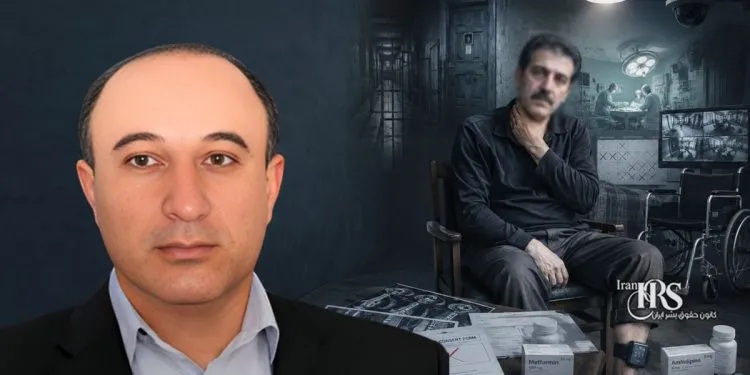
The Saqqez Revolutionary Court has opposed the request for conditional release of Hassan Bahari, a Kurdish political prisoner; this is while he suffers from multiple illnesses including diabetes, high blood pressure, chronic dizziness, and severe cervical disc, and doctors have warned about the necessity of urgent surgery for him.
Iran Human Rights Society, Tuesday June 23, 2026 – Hassan Bahari, a political prisoner from Saqqez who after years of imprisonment is now serving his sentence in the form of house arrest with an electronic ankle monitor, is facing serious physical problems. Despite doctors’ emphasis on performing urgent surgery to prevent irreparable damages, Branch One of the Saqqez Revolutionary Court has opposed his request for conditional release. This decision has been made while his physical condition has been completely known to judicial authorities and case officials.
Why is Hassan Bahari’s physical condition described as concerning?

Based on published reports, Hassan Bahari has faced multiple physical problems during the years of imprisonment. Diabetes, high blood pressure, constant dizziness, and complications resulting from years of prison are among the illnesses that have affected his health. In the latest medical examinations, doctors have confirmed his affliction with severe cervical disc. This complication has progressed to the extent that it has caused serious disruption to the function of his left hand. Doctors have warned that if the surgery is postponed, there is a possibility of permanent and irreversible damages occurring.
Human rights activists believe that in such conditions, providing access for the prisoner to appropriate medical services should be a priority and humanitarian considerations should prevail over security restrictions.
Why did the court oppose Hassan Bahari’s conditional release?
Based on published information, Mojtaba Ghaffari, the judge of Branch One of the Saqqez Revolutionary Court, opposed the request for conditional release of Hassan Bahari in late Ordibehesht. This decision has been made while Hassan Bahari had previously been released from prison due to the deterioration of his physical condition and transferred to house arrest with an electronic ankle monitor. Critics say that opposing conditional release in conditions where the prisoner is facing multiple illnesses and urgent need for treatment raises serious questions about attention to humanitarian considerations in judicial decisions. According to informed sources, judicial authorities and case officials had complete information about Hassan Bahari’s medical condition, but this issue had no effect on the court’s final decision.
How has house arrest made his treatment process more difficult?
Although the transfer of Hassan Bahari from prison to house arrest was apparently considered an action to reduce pressures resulting from prison, the restrictions resulting from the electronic ankle monitor and continuous monitoring still continue. He must obtain multiple judicial and security permits to refer to treatment centers and carry out treatment stages. Human rights activists say this time-consuming process, in the case of illnesses that require urgent attention, can endanger the health and even the life of the prisoner. These restrictions are applied in conditions where doctors have emphasized the necessity of accelerating the treatment process and consider any delay as a factor in intensifying physical damages.
Examination of the case’s rights based on domestic laws Legal ambiguities of the case
In Hassan Bahari’s case, this question is raised that despite official confirmation of multiple illnesses and urgent need for surgery, what legal reasons have existed for opposing his conditional release. Also, it is not clear whether the physical condition and the opinion of specialist doctors have been fully considered in the judicial decision-making or not.
Related legal articles Article 58 of the Islamic Penal Code
Has foreseen the conditions for using conditional release for qualified convicts.
Article 502 of the Code of Criminal Procedure In cases of the prisoner’s illness and impossibility of enduring imprisonment, it foresees the possibility of postponing or stopping the execution of the punishment.
Principle 22 of the Constitution Emphasizes the preservation of life, rights, and dignity of persons. Principle 29 of the Constitution Considers enjoying medical services and healthcare as the rights of citizens.
Instances of law violation Insufficient attention to the prisoner’s medical condition Ambiguity in examining the opinion of specialist doctors Possibility of limiting the right to effective access to treatment Ambiguity in observing legal standards related to ill prisoners Possibility of not using legal capacities for reducing or suspending the punishment in illness conditions
Violation of human rights; depriving the ill prisoner of complete access to treatment and enjoying humanitarian measures
Human rights activists believe that Hassan Bahari’s case is an example of existing challenges in the field of rights of ill prisoners. They emphasize that enjoying appropriate medical services and unobstructed access to medical care is among the fundamental rights of all prisoners.
Violated articles
Violation of the right to enjoy health and medical services – Article 25 of the Universal Declaration of Human Rights Delay in access to specialized treatment can endanger the health and life of the prisoner.
Violation of the principle of human dignity of prisoners – Nelson Mandela Rules Ill prisoners must enjoy medical care appropriate to their physical condition.
Violation of the right to enjoy humane treatment with persons deprived of liberty – Article 10 of the International Covenant on Civil and Political Rights Restrictive conditions should not hinder the prisoner’s immediate access to necessary medical services.
Violation of the right to life and physical health- Inattention to medical warnings about serious illnesses can bring irreparable consequences for the prisoner.
While Hassan Bahari’s physical condition is still described as concerning, human rights activists and defenders of prisoners’ rights have demanded the provision of the possibility of urgent treatment, removal of existing obstacles, and review of the decision opposing his conditional release.
See also the below articles:
- Ehsan Vineh; 170 Days of Absolute Lack of News from the Fate of a Kurdish Citizen in Kermanshah
- Houshang Fahandezh: Savage Rape of Female Students in 2009 Shiraz Protests
Follow Iran Human Rights Society on social networks:
Telegram /Twitter /Instagram / YouTube / Facebook
Join Iran Human Rights Society on Twitter