
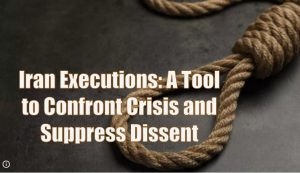
Iran saw a wave of executions on Dec 21-22, 2025, with at least 21 people hanged in multiple prisons.
Iran Human Rights Society, December 22, 2025 – On December 22, 2025 Jamshid Nourmohammadi was executed in Kashan, Majid Ahmadi in Neyshabur, and Iman Bakhshi in Saveh. Nourkhoda Moradi was executed in Doroud, while Abbas Omidi met the same fate in Zanjan. In Kerman, a prisoner known only by the surname Mashiri was executed, and Aydin Nourzad in Gorgan. Additionally, two prisoners were executed in Dastgerd, Isfahan.
The previous day, on December 21, 2025, executions continued with two Afghan nationals in Taybad, Fardin Khani in Arak, and Amir Mohammad Jadidi in Qazvin. Two prisoners were executed in Tabriz, Ali Mohammad Koushki in Borujerd, Vahid Pazouki in Semnan, Kazem Sourian in Qom, Reza Dastdar in Bandar Abbas, and Fariborz Ghasemi in Yasuj.
Earlier, on December 2, 2025, a prisoner was executed in public in Borazjan.
The incompatibility of the death penalty with the Universal Declaration of Human Rights
Article 3 of this Declaration explicitly states: Everyone has the right to life. This right shall not be deprived except pursuant to a judgment issued by a competent court as a result of committing a crime that is considered a crime in accordance with the law.
The death penalty, as the highest punishment, is directly in conflict with this article of the Universal Declaration of Human Rights. Because:
Right to life: The right to life is presented as a fundamental and inalienable right. The death penalty deprives this right.
Irreversibility: In case of execution of the death penalty, there is no possibility to compensate for judicial error.
Torture and inhuman treatment: Some methods of executing the death penalty are considered torture and inhuman treatment, which itself is contrary to the provisions of the Universal Declaration of Human Rights.
Violation of human rights obligations regarding the death penalty
According to Article 6 of the International Covenant on Civil and Political Rights, which Iran is one of the signatories, the issuance and execution of the death penalty is only permitted in the presence of full guarantees for a fair trial and in very serious crimes. In many similar cases, lack of transparency, legal restrictions on the defendant, and issuance of judgments in courts lacking the necessary independence, are considered contrary to this fundamental human rights principle.
See also the below articles:
- Political Prisoners Hakimeh Honarmandi and Rouhollah Eskandari Endure One-Year Limbo in Iran
- Mohammad Javad Vafaei Thani Execution Risk Escalates Amid Solitary Confinement and Retrial Rejection
Follow Iran Human Rights Society on social networks:
Telegram /Twitter /Instagram / YouTube / Facebook
Join Iran Human Rights Society on Twitter






Discussion about this post