
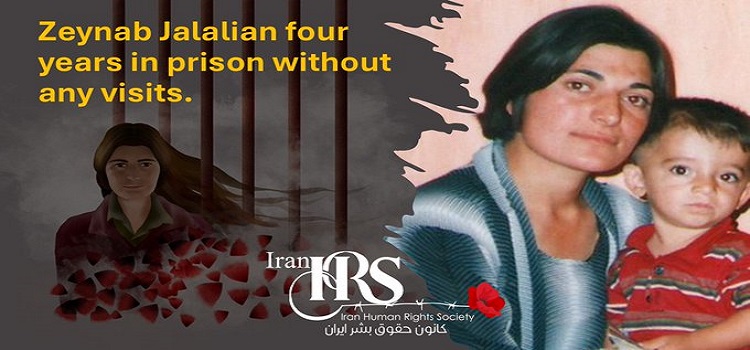
For the past four years, political prisoner Zeinab Jalalian has been denied the right to meet with her family. This prohibition is part of the broader efforts by authorities to isolate her and exert additional pressure.
Zeinab Jalalian, a political prisoner, incarcerated in Yazd Prison for the past four years, during which time she denied the opportunity to meet with her family. Some of her family members, who had traveled from Maku to Yazd to visit her, forced to turn back midway upon learning that she was prohibited from receiving visitors.
According to a report from the Iran Human Rights Monitor, on Sunday, October 1, 2024, Zeinab Jalalian was barred from having in-person visits by order of the authorities at the Ministry of Intelligence and Yazd Prison. Since her transfer to Yazd Prison four years ago, she has been unable to see her family. Some of her family members who had journeyed from Maku to Yazd to visit her were compelled to return midway after informed of the visitation ban.
Zeinab Jalalian is also experiencing severe pain in her right side. During a CT scan at the Farrokhi Yazdi Hospital, the prison authorities did not remove her handcuffs and shackles, forcing her to undergo the procedure in that restrained state.
Medical Care Conditioned on Writing a Letter of Repentance
Access to necessary medical care for Jalalian has been made conditional upon her writing a letter of repentance, effectively coercing her into admitting guilt in exchange for essential healthcare services. This tactic commonly used as a method of further pressuring political prisoners to denounce their beliefs or actions.
The physical condition of the Zeinab Jalalian deteriorated in recent months due to the severe pain in her right side.
Political prisoner Zeynab Jalalian, during her arrest and afterwards due to severe physical torture, has developed vision problems. Since then, she has suffered from various medical issues including visual disturbances, pterygium, asthma, kidney problems, and gastrointestinal issues. She has been enduring these hardships for years due to the lack of medical attention from the authorities.
Return to the Cell without Specialist Consultation
In early July 2023, political prisoner Zeynab Jalalian transferred to the prison infirmary due to severe pain in her right side but was returned to her cell without being examined by a specialist.
She has been suffering from pain in her right side for a long time, yet prison officials have taken no serious action to treat her or transfer her to an outside hospital for a specialist consultation. By doing this, prison officials seem to be attempting to torture her.
Currently, due to lack of medical care, spots and rashes have appeared on parts of her face, shoulders, and chest. She requested to be transferred to an outside hospital for an ultrasound and tests, but so far, her requests gone unaddressed.
In June 2023, a team of interrogators and officials from the Ministry of Intelligence met with her twice in central prison of Yazd. And requested that she write a letter of regret in order to receive medical attention for her issues. Zeynab Jalalian rejected this request, asserting that her right to treatment and conditional release for medical care is a legitimate right.
Threatened by a team of interrogators from the Ministry of Intelligence,
In November 2022, she also threatened by a team of interrogators from the Ministry of Intelligence, who stated that as long as she did not express regret, she would be deprived of all her basic rights, including access to medical services. She considered this action by the Ministry of Intelligence officials as a form of torture and firmly rejected it.
Zeinab Jalalian, a Kurdish political prisoner, was born in 1982 in the village of Dim Qeshlaq, Maku, in West Azerbaijan Province. She was arrested by security forces on March 10, 2008, on the Kermanshah-Sanandaj Road. Jalalian charged with “Moharebeh” (enmity against God) for allegedly collaborating with the PJAK group and sentenced to death in 2009. Her trial took place without a defense attorney and lasted only a few minutes. In 2011, her death sentence commuted to life imprisonment.
Throughout her imprisonment, Jalalian subjected to severe physical and psychological torture. She has resisted pressures to participate in forced confessions and televised interviews, leading to her repeated transfers between various prisons.
During her 4 years in prison. Jalalian has suffered from serious health issues due to a lack of access to medical care. The deliberate denial of medical attention considered a form of torture and a violation of human rights. Despite her critical condition, Jalalian never granted medical leave and remains imprisoned in Yazd prison, still denied adequate healthcare.
Increased Pressure for Forced Confessions
Jalalian continuously subjected to immense pressure to provide forced confessions. Despite repeated attempts by authorities to coerce her into making false statements on camera, she has steadfastly refused to comply, enduring significant physical and psychological harm as a result.
Zeinab Jalalian repeatedly pressured to appear on camera and give forced confessions and interviews. However, she resisted and refused to comply.
She was held for some time in Dizel Abad Prison in Kermanshah. And, in December 2014, transferred to Khoy Prison without prior notice to her family or lawyer. On May 10, 2020, Jalalian suddenly moved from Khoy Prison to Qarchak Varamin Prison.
On June 25, 2020, while on a hunger strike, Zeinab Jalalian transferred from Qarchak Varamin Prison to Kerman Prison. She kept in solitary confinement in Kerman while already in poor health after contracting COVID-19 in Qarchak Prison, further worsening her condition.
On Wednesday, September 22, 2020, after three months in solitary confinement and in critical health, she moved from Kerman Prison back to Kermanshah Prison.
On November 10, 2020, during a brief phone call with her family, Jalalian informed them that she had been transferred to Yazd Prison.
After multiple relocations between different prisons, she currently held in Yazd Prison. Despite 15 years of imprisonment, she never granted a single day of medical leave for essential healthcare and treatment.
Denial of Medical Care as a Form of Torture and Human Rights Violation

Deliberate denial of access to medical care for prisoners considered an act of torture or cruel, inhuman, or degrading treatment. Such actions classified as international crimes and strongly condemned under international human rights law and international humanitarian law.
December 10, 1948 – Adoption of the Universal Declaration of Human Rights
Violation of the Universal Declaration of Human Rights through Denial of Medical Care
Right to Life (Article 3): This right not only refers to the preservation of physical life. Also includes the right to enjoy conditions that ensure a healthy life. Access to healthcare is one of the most critical aspects of this right.
Right to Liberty and Security of Person (Article 9): Every individual has the right to liberty and personal security. This also applies to conditions in prison, where access to proper healthcare is an essential part of securing the dignity and well-being of detainees.
It is important to note that the rights outlined in the Universal Declaration of Human Rights are universal and indivisible. This means that you cannot deprive someone of one right on the pretext of enjoying other rights.
The Universal Declaration emphasizes the principle of equality for all human beings, without discrimination. It is based on race, gender, religion, or any other factor. Prisoners are not exempt from this principle and have the right to the same rights and protections as free individuals.
Follow Iran Human Rights society on social networks:
Telegram /Twitter /Instagram / YouTube / Facebook
Join Iran Human Rights Society on Twitter






Discussion about this post